AI for Cochlear Implants: Solving the Speech-in-Noise Challenge at Scale

Cochlear implant users often achieve strong speech recognition in quiet environments but struggle in real-world settings where multiple voices compete. For healthcare leaders, this gap represents more than a usability issue. It is a persistent quality-of-life and equity challenge that current device architectures do not fully solve. In a HealthAI Collective Lightning Talk, Karen Barrett outlined how a machine learning pre-processing layer could selectively enhance a target speaker, offering a scalable path to improving speech-in-noise performance across device platforms.
Key Takeaways
- Speech-in-noise remains one of the largest unmet needs for cochlear implant users.
- AI can act as a pre-processing layer to isolate target speech rather than replace device hardware.
- Platform constraints such as compute, microphone variability, and manufacturer differences determine feasibility.
- Target speaker selection is a core product and clinical decision, not a technical afterthought.
- Validated audiology outcome measures must anchor performance claims.
- Pilot-first funding de-risks high-impact healthcare AI before scale.
Why Speech-in-Noise Remains an Unsolved Problem for Cochlear Implants
Cochlear implants can deliver strong speech recognition in quiet environments. However, performance declines sharply when multiple speakers compete for attention.
This gap reflects a biological constraint. Implants rely on approximately 12 to 20 electrodes to stimulate the cochlea, replacing the function of thousands of inner ear hair cells. The resulting auditory signal is compressed and degraded, making spatial separation and selective attention significantly harder.
In hearing science, the brain’s ability to focus on one speaker in a noisy setting is known as the cocktail party effect. For cochlear implant users, this filtering mechanism is fundamentally limited by the signal quality available to the brain.
Executive implication: This is not a marginal usability issue. Difficulty understanding speech in noise affects social participation, workplace inclusion, and quality of life. For healthcare leaders, it represents a measurable patient experience and equity challenge rather than a feature refinement.
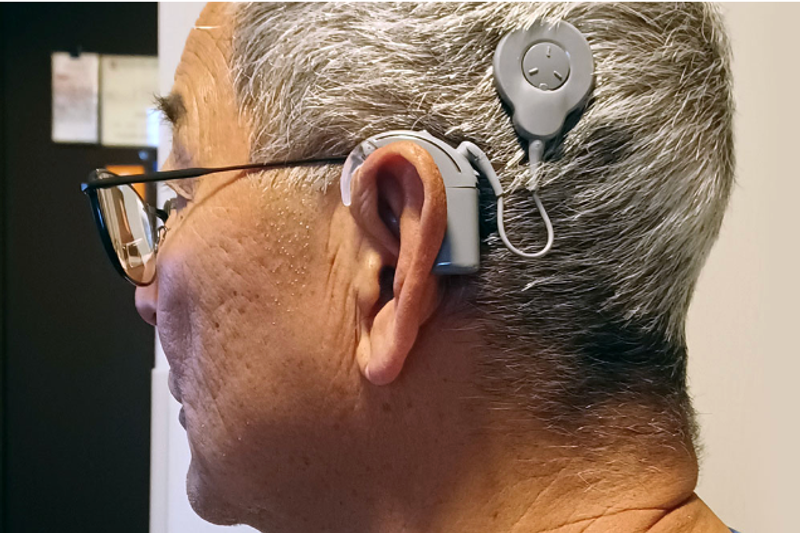
How AI Can Pre-Process Speech for Cochlear Implant Users
The core idea is conceptually simple but technically demanding: use machine learning to isolate a target speaker while suppressing competing voices.
This is not a generic noise reduction effort. Cochlear implant processors already reduce steady environmental noise such as fans or background hum. The harder challenge is speech competing with other speech.
The initiative reframes the problem as pre-processing. In natural hearing, neural circuits bias incoming sound toward speech before higher-level interpretation occurs. Cochlear implants provide limited biological pre-processing, creating an opportunity for an external machine learning layer.
Executive implication: This is not an abstract AI application. It targets a clearly defined functional limitation and attempts to augment existing device architecture without replacing it.
How Pilot-First Strategy De-Risks Healthcare AI Deployment
The project is structured as a high-risk, high-reward pilot focused on feasibility rather than guaranteed outcomes. The immediate goal is not productization, but determining whether selective speech enhancement is technically viable for cochlear implant users.
This level of uncertainty is intentional. Instead of committing to full-scale development, the team is validating core assumptions before pursuing larger funding or device integration.
Executive implication: This mirrors disciplined healthcare AI deployment. Establish feasibility, test against validated measures, and only then pursue scale. Many AI initiatives fail because organizations attempt integration before proving functional value.
By framing the work as a pilot, risk is contained while learning is accelerated.
The Proposed Workflow: From Feasibility to Scalable Deployment
The initiative follows a phased path designed to test feasibility before pursuing scale.
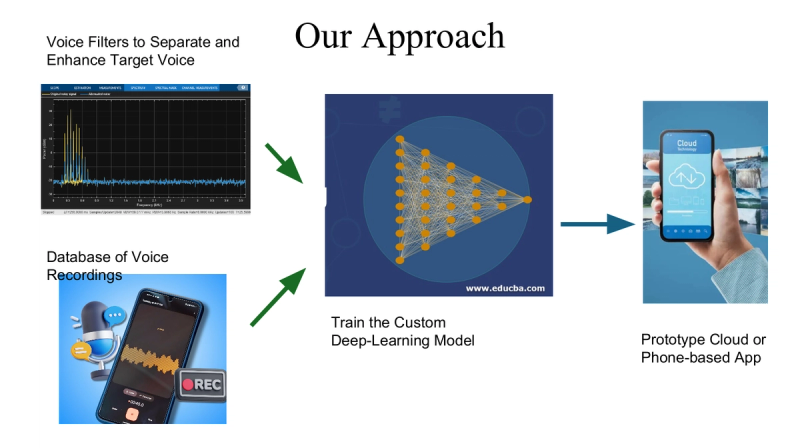
1. Identify viable speaker isolation tools
The team is evaluating open-source algorithms capable of isolating a target speaker in noisy environments, prioritizing solutions that can operate across different cochlear implant platforms.
2. Train models on realistic speech-in-noise scenarios
Deep learning models will be trained using limited recordings of preferred voices, clinical speech-in-noise materials, and synthetic augmentation where needed. The objective is not perfection, but proof of concept.
3. Prototype application layer
Early development focuses on understanding compute requirements, training time, and integration constraints rather than building a full product.
4. Build evidence for larger funding and partnerships
If feasibility is demonstrated, the next phase involves pursuing NIH or NSF funding and exploring collaboration with device manufacturers.
Executive implication: Many healthcare AI efforts fail during integration. By mapping technical validation to funding strategy and platform realities early, the project reduces downstream deployment risk.
What are the operational and product decisions leaders should watch?
Several execution realities surfaced during discussion, each carrying meaningful implications for scale.
Target Speaker Selection
The central design challenge is determining whose voice to enhance. Proximity, familiarity, and user preference are possible anchors, but ambiguity remains unavoidable in dynamic environments.
Executive decision criteria:
- How is the target speaker defined?
- How is user intent captured?
- How does the system respond when ambiguity cannot be resolved?
Compute and Deployment Constraints
On-device processing may exceed current hardware limits. Alternatives such as phone-based or cloud-based processing introduce tradeoffs across latency, reliability, and privacy.
Data Realism and Signal Mismatch
Training data may not perfectly replicate the auditory signal cochlear implant users receive. Signal mismatch risks undermining otherwise strong models.
Post-Processing Risk
Traditional signal processing layers can unintentionally degrade machine learning outputs. End-to-end evaluation becomes essential.
Executive implication: Success will depend less on model accuracy in isolation and more on how these operational decisions are resolved before deployment.
How Performance Should Be Evaluated for Clinical and Executive Confidence
Performance must be measured using validated audiology outcome measures already embedded in clinical care. The project relies on established sentence and word recognition tests in noisy environments that cochlear implant users routinely complete during audiology visits.
This approach ensures that evaluation reflects functional improvement rather than abstract model metrics. Gains must translate into measurable changes in speech understanding under realistic listening conditions.
About the Speaker
Karen Barrett is an auditory cognitive neuroscientist and assistant professor at the University of California, San Francisco. She holds a joint research appointment with the Institute of Health & Aging at the UCSF School of Nursing and the Department of Otolaryngology at the UCSF School of Medicine and is also a collegiate faculty member at the San Francisco Conservatory of Music. Her work focuses on the neuroscience of creativity, music perception in cochlear implant users, and the role of music in health and aging. She also serves as a scientific analyst for the Sound Health Network.
Watch the Full Talk
AI for Cochlear Implant Users